What Is a B-tree Indexes in PostgreSQL?
A balanced tree keeps keys sorted. Branch nodes narrow a search to a smaller range, and a leaf entry identifies matching table rows. PostgreSQL creates B-tree by default.
How the B-tree Indexes Algorithm Works
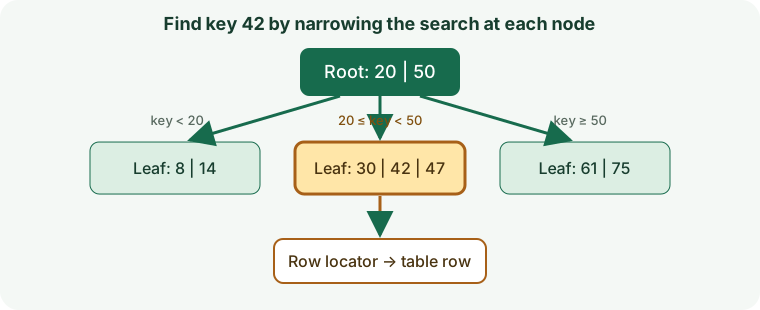
A balanced tree keeps keys sorted. Branch nodes narrow a search to a smaller range, and a leaf entry identifies matching table rows. PostgreSQL creates B-tree by default.
When to Use B-tree Indexes
Equality, range comparisons, BETWEEN, IN, sorting, IS NULL, and some left-anchored patterns.
How to Create a PostgreSQL B-tree Indexes
Review data quality, existing structures, feature support, build time, and deployment requirements before creating an index on a production table.
CREATE INDEX orders_created_at_idx ON orders USING btree (created_at);B-tree Indexes Query Example
This example demonstrates the matching query shape. Check the execution plan to confirm that the engine can use the index.
SELECT order_id FROM orders WHERE created_at >= DATE '2026-01-01' ORDER BY created_at LIMIT 20;Queries Supported by B-tree Indexes
Equality, range comparisons, BETWEEN, IN, sorting, IS NULL, and some left-anchored patterns. A similar-looking predicate may not use the same access path; operators, expressions, key order, and data type all matter.
Read Performance, Storage, and Write Costs
The index changes for inserts, deletes, and indexed-key updates. Wider keys consume more pages and increase write work. Indexes reduce some search work but require storage and add maintenance to writes.
B-tree Indexes Limitations and Common Mistakes
Leading-wildcard LIKE searches are not ordinarily supported. Operator classes and collation affect pattern matching.
Do not assume that an index being present means the optimizer chose it or that the query became selective.
How to Measure and Tune B-tree Indexes
Check EXPLAIN (ANALYZE, BUFFERS), actual rows, heap reads, and whether the index avoids sorting.
Compare representative plans and timings before and after, including concurrent writes and realistic data volumes.
B-tree Indexes Questions
Will the database always use this index?
No. The optimizer weighs selectivity, estimated costs, statistics, cache state, and the amount of data returned.
What should I verify before production?
Confirm version support, query compatibility, write overhead, build/rollback procedures, and index behavior during backup and recovery.
Official PostgreSQL Index Documentation
Check PostgreSQL documentation: Index Types for release-specific requirements and supported operators.